The landscape of English language education in the post-secondary context is changing rapidly. Online classes have become the preferred modality for many students and teachers alike. E-books are now the default option from publishers and campus bookstores. Most noticeably, Generative Artificial Intelligence (GenAI) has become omnipresent, offering to simplify burdensome administrative tasks and lesson planning for teachers, while simultaneously posing a serious threat to the integrity of their assessments. Despite the huge potential of GenAI, the threat it poses to academic integrity has given many English language teachers in higher education pause. Unsure of where to begin, many teachers are hesitant to welcome GenAI into their classrooms. In what contexts should it be introduced to learners? Which of its many capabilities are applicable to their learners and to what end?
International educational organizations, such as UNESCO (2024), have recognized the potential of GenAI, “to profoundly reshape societies, economies and education systems... [and that it] poses unique ethical and social challenges.” In 2025, UNESCO published two Artificial Intelligence (AI) competency frameworks, with the intention of providing guidelines for teachers and students to use AI in a thoughtful and responsible manner. These frameworks adopt a humanistic approach, in which this technology supports human thought and process but does not replace it. Included in these frameworks are competencies focused on user mindset, ethics, techniques, and design. However, these frameworks are general, not context-specific, and thus require further consideration when determining how best to introduce them into one’s own classroom.
Indeed, the post-secondary English language education context is not like others; learners come with diverse educational, and cultural backgrounds, and thus varying degrees of digital literacy. Yet a lack of digital literacy in the post-secondary context can hinder academic achievement; navigating their institution’s learning management system (LMS), accessing academic resources, and even completing assessments, all depend on digitally literate learners. Taking into consideration such varying digital skillsets, how can one form of AI (e.g. GenAI) be introduced in an English language education classroom? What knowledge and skills related to GenAI do learners need to develop to become responsible, proficient users of the technology?
Professors Hayley Goodwin and Sara Machan sought to explore these questions further in their own teaching context. Hayley and Sara teach at a public post-secondary institution located in the Greater Toronto Area in Ontario, Canada. Their student population is mostly comprised of newcomers, ranging in ages from 18 – 65, who are in the process of building a new life in Canada, alone or with their families. In Fall 2025, Hayley and Sara began experimenting with incorporating GenAI into their inperson classroom teaching practices. In the context of this research, GenAI refers to digital tools, specifically Chat GPT and Microsoft Co-pilot, that can generate novel content based on large language datasets. Hayley and Sara began by focusing on prompt writing with their learners. They then experimented with various interactive and reflective speaking tasks that sought to develop the critical and digital literacy of their learners. A total of 15 learners from two different A2-level classes agreed to participate in the study, providing their feedback on the teachers’ pedagogy and their own perceptions of the technology through two surveys and an interview.
This toolkit is the product of classroom experimentation and observation, teacher reflection, and learner feedback. Included in this toolkit is a summary of best practices, which provide teachers with clear rationales and detailed steps for introducing GenAI into the classroom and conducting GenAI-integrated activities. Also included are ‘teacher tips’ and sample classroom activities, which can be immediately adapted and implemented into the classroom. We hope this toolkit illustrates the potential of this tool to enhance your learners’ educational and language learning experience.
Hayley Goodwin is an EAP Professor at Sheridan College located in Mississauga, Ontario, Canada. She holds the CELTA, DELTA, and OCELT teaching qualifications, and an MA in Applied Linguistics. In addition to 15+ years of teaching experience locally and abroad, Hayley has also been a CELTA tutor for over 10 years. She is an avid action researcher in her own classroom and sees the positive impact it has on both her students and her own professional development.
Sara Machan is an EAP professor at Sheridan College in Oakville, Ontario, Canada. She holds a CELTA, OCELT teaching qualifications, and an MA in Applied Linguistics from Mary Immaculate College, Limerick, Ireland. She has over 10 years of teaching experience in various contexts. She is passionate about gamification and AI use both in the classroom and for lesson planning and coding interactive learning materials. She has extensive webinar and presentation experience and enjoys sharing new knowledge with other instructors.
Madhumini Rajapakse is an ESL instructor at the Association for New Canadians in St. John’s, Newfoundland and Labrador, Canada, and a former EAP Professor at Sheridan College in Mississauga, Ontario, Canada. She holds a bachelor’s degree in English and is CELTA and OCELT qualified. She has 10 years of experience teaching ESL to adults in diverse contexts. She is currently pursuing a Master of Education at Memorial University of Newfoundland, with a research focus on the use of Generative AI in teaching and learning. She is passionate about innovative pedagogy, learner autonomy, and the ways AI can support ESL learners.
Dana Victor Hazin is an EAP Professor at Sheridan College. She has an OCELT and CELTA certification and holds a BA in English Language and Literature. Dana’s teaching approach focuses on creating interactive and inclusive learning environments where students can build confidence in their language skills, specifically their speaking skills. Dana also holds a Master of Science in Poverty Reduction and has more than 20 years’ experience in writing and editing for the international humanitarian field.
Digital literacy is no longer seen as a bonus skill but a global necessity. According to the World Economic Forum Future of Jobs Report 2025, technology skills, specifically AI, top the list of core skills that are projected to grow in importance more rapidly than any other skills by 2030. Cognitive skills such as creative and analytical thinking as well as the selfefficacy skills of resilience, flexibility, agility, curiosity, and lifelong learning are also expected to rise in importance over the next five years.
While these 21st-century skills have long been incorporated in modern language teaching literature, introducing GenAI in the classroom provides a unique opportunity to further develop these skills. For instance, learners can build self-efficacy when they gain the confidence to reject an AI tool’s suggestion because it does not match their own voice or intended meaning. Learners also practice cognitive skills by analyzing AI output, comparing options, and choosing the best language for their purpose.
This study uses the UNESCO definition of digital literacy, which moves beyond basic use of digital tools to include the ability to understand, communicate, create, and evaluate digital content. The following findings examine how learners developed digital literacy alongside AI self-efficacy and critical awareness over the span of the course.
Mid-Course Survey Findings: The Baseline
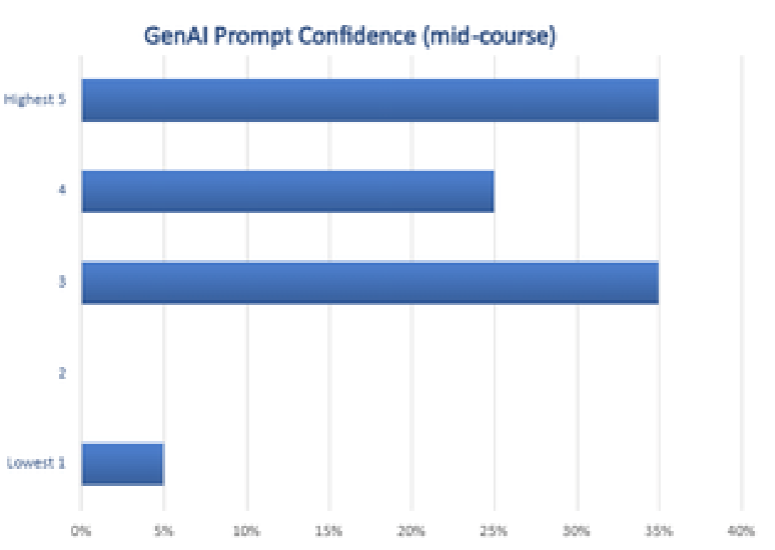
The study’s mid-course survey served as the initial baseline for measuring the learners’ experience with GenAI. Although many learners said they were using GenAI tools for the first time, "digital self-efficacy" (confidence) was notably high at this point. The results show that 35 per cent of learners had never used GenAI before this course. However, their confidence in writing prompts was strong only a few weeks after introducing GenAI tools in the classroom.
This high initial confidence suggests that adult learners are not necessarily "digital beginners." By applying existing skills from tools like messaging apps, learning platforms, and search engines, learners may have found the GenAI interface familiar. GenAI was treated similarly to a chat app, which made the transition easier.
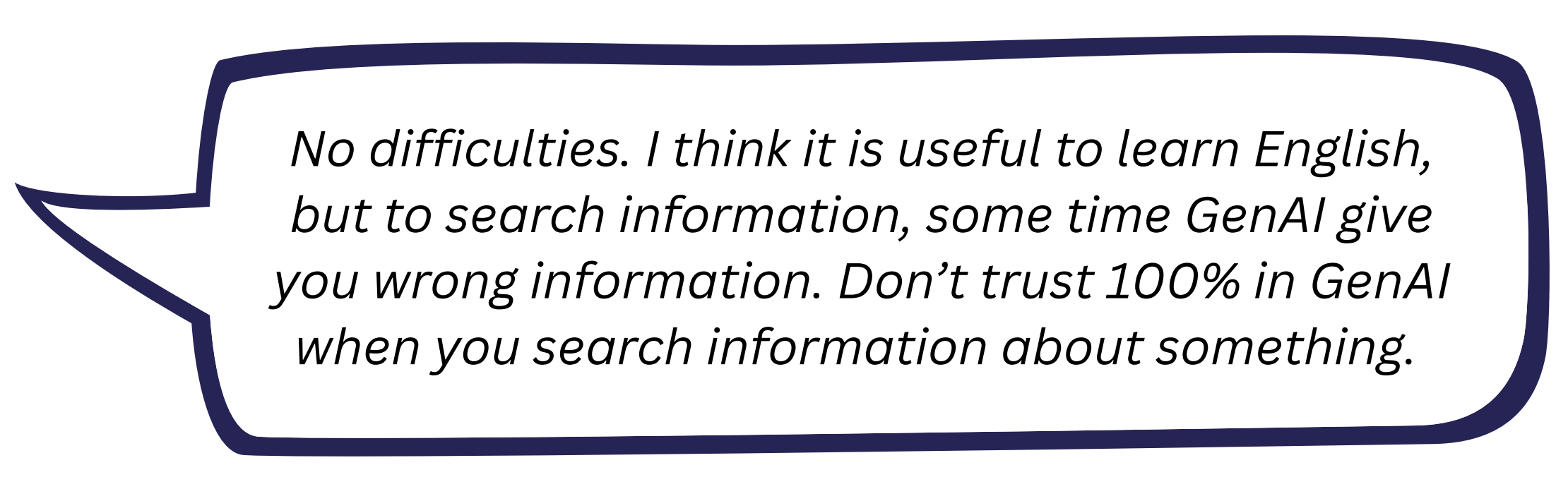
In the mid-point survey, learners were asked about the difficulties they had using GenAI in class or at home. The results show that only a small number of learners mentioned facing any. The difficulties mentioned were not related to the technology itself but rather to communication and prompt accuracy. One learner recognized that the quality of the AI's output depends on their own input. This shift from "how do I use this?" to "how do I ask this correctly?" indicates that some learners were quickly moving beyond the basic accessing stage of digital literacy. They started to learn how to manage and evaluate digital information to ensure it met their specific learning needs.
Image spot: Mid-Course Survey ChartAdd mid-course-survey.png to the images folder.
-replace me with an image caption-
Image spot: Mid-Course Speech BubbleAdd mid-course-quote.png to the images folder.
-replace me with an image caption-
End-of-Course Findings
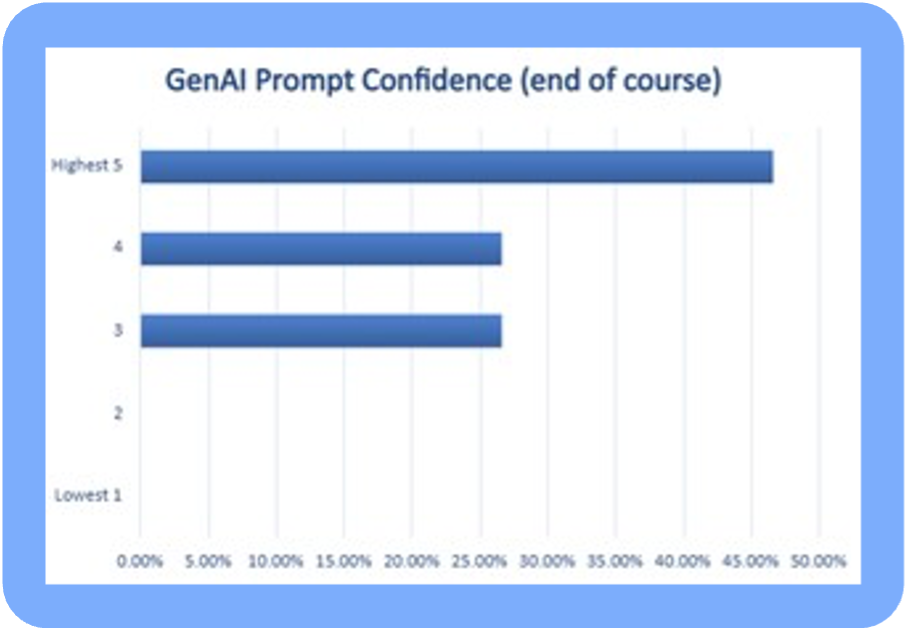
The findings at the end of the course are drawn from survey data, final interviews, teacher reflections, and classroom observations. The survey results show a significant increase in digital confidence. By the end of the course, learners demonstrated a higher level of "digital self-efficacy" as the percentage of learners who felt "very confident" writing prompts in English to access the information they want increased from 35 per cent to
46.67 per cent.
The most notable finding was the complete disappearance of "nonconfidence". Learners who reported feeling "unconfident" dropped from 5 per cent at the mid-point to 0 per cent by the end of the course.
08
These numbers indicate that sustained use of GenAI can lead to digital fluency. As learners spent more time with the tool, their initial hesitation to use it was replaced by a sense of control and mastery.
This disappearance of non-confidence can be attributed to the affective environment GenAI creates. Unlike human interlocutors, GenAI was perceived as a "patient" and "devoted" tutor that "does not have emotions." Learners reported feeling safe to ask unlimited questions because it does not get bothered, which essentially lowers the affective filter. This psychological safety allowed even low-level English language learners to experiment with the language without fear of judgment.
Interestingly, the confidence gained from using GenAI seemed to spill over into other digital areas. One learner shared how they now use ChatGPT to solve technical problems, like navigating programs on their laptop (e.g. PowerPoint). Another mentioned that their interest in technology has expanded to following AI news and creating presentations. This indicates that GenAI can serve as a 'bridge' to greater digital literacy.
The data also showed that learners’ digital literacy grew as they learned to write prompts. This was clear when learners moved from following teacherled templates to writing prompts independently. While teachers initially modeled examples on the board such as “I am an A2 level student. Can you help me prepare a presentation? But don’t do the work for me” by the final weeks, learners were constructing these prompts on their own. This ability to self-identify their language level and set boundaries for the AI may indicate a shift from simply using a tool to independently managing their own learning.
Image spot: End-of-Course SurveyAdd end-of-course-survey.png to the images folder.
-replace me with an image caption-
Development of Critical Awareness
While the primary objective of this study was to improve digital literacy skills, the data from the final interviews suggests that the learners progressed much further. They did not just learn how to use the tool (basic digital literacy); they developed a 'critical filter' for its application. This higher-level awareness can be grouped into three main areas:
09
1) "Healthy Skepticism"
Many learners realized that AI is "never perfect" and can make mistakes. One learner noted, “I don't trust the answer... I have to look for more details.” Another suggested a "80/20 rule," trusting AI only 80% and using their "own kind of brain" for the rest. One learner even challenged the tool: “I ask: Why did you write this? Because it is not correct... and it says
‘sorry.’”
2) Privacy and Data Security
Learners also showed a strong understanding of digital safety. They were careful about what they shared with the big database. Learners explicitly warned, “Don’t give more information about yourself” and “Don’t share sensitive information.” One learner said they use "fake names and locations" to protect their identity while practicing.
3) Ethics: Learning vs. Cheating
The data highlighted a significant ethical distinction between using GenAI as a learning aid versus using it as a shortcut. A learner explained that the purpose of GenAI is “to help us build ourselves, but not like to use them in tests.” They identified that using GenAI to do the work for you is "dangerous" because if the tool does the work, the learner fails to develop their own skills.
Furthermore, the data revealed a shift in perception. One learner admitted they used to think GenAI was only "negative," but after the course, they realized that “if we use it correctly, it’s a very good friend.”
In conclusion, the findings suggest that the true value of GenAI in the classroom lies in the humanistic skills it builds. The fact that 'nonconfidence' disappeared by the end of the course shows that GenAI can create a safe space for learners to experiment with language. However, the real growth was seen in the learners’ willingness to question the tool. The learners moved from simply using the AI tools to evaluating their output and started to develop critical awareness needed to stay in control and navigate the digital world safely and ethically.
DIGITAL LITERACY · PDF PAGE 10
Eight Tips to Help Learners Move from Basic Digital Access to Understanding, Creating, and Evaluating Digital Content
1. Teach learners that GenAI is a helper and not a replacement.This helps them understand that the value of the tool depends on their own effort.
2. Model "Goal-Oriented" prompts. Start by modeling a clearprompt on the board that includes the learners’ level and specific goals. As the course progresses, move from providing the full prompt to only providing a ‘prompt checklist,’ helping learners eventually write their own prompts.
3. Teach learners to talk back. To get closer to the desiredoutput, they need to learn to refine their prompt(s).
4. Remind learners that AI is not a real person. It is a tool tosupport learning, not a substitute for real communication.
5. Help learners understand that GenAI can make mistakes. Encourage them to be skeptical. They should always check the AI output to see if it is true, if it sounds natural, and if it fits their voice and intended meaning.
6. Discuss the difference between using AI to prepare (learning) and using it to produce final work (plagiarism). This will help them develop critical awareness necessary to use the tool ethically.
7. Occasionally, project an AI response on the class screenfor group evaluation. You can collect mistakes or inaccurate responses you’ve caught from GenAI and turn them into an activity where learners compete to identify the errors. This empowers them to see themselves as the boss of the technology rather than just passive users.
8. End AI-integrated activities with a moment of reflection. Asktwo simple questions: “How did the AI help you today?” and “How many times did you have to talk back to AI before it gave you what you wanted?” This reminds the learners that they are the ones in control of the technology.
In the English language classroom, educators are encouraged to provide learners with the tools and skills necessary to become autonomous, able to take charge of their own learning and gain the ability to problem solve (Yu, 2020). As learners become autonomous, there is potential for a deeper understanding of the language and improved fluency, as they are continuing their studies beyond the classroom, guided by curiosity and necessity. The concept of learner autonomy can also be applied to the use of GenAI and its impact on language learning. In this context, the goal is for learners to develop independence not only in using the technology itself, but also in using it as a tool to support their language learning and development. Therefore, learner autonomy in this area can be understood as two-fold: autonomy in using GenAI tools and autonomy in developing language skills.
To achieve meaningful independence with GenAI, scaffolding and sound pedagogy must take place in the classroom. Teachers play an important role in introducing AI thoughtfully and guiding learners in how to interact with it effectively. This includes teaching learners how to write clear prompts, evaluate AI-generated responses, and understand the limitations of AI tools. By modelling appropriate prompting strategies and providing guided practice in class, teachers help learners build the confidence and critical thinking skills necessary to use AI responsibly and effectively beyond the classroom.
This integration of AI in the classroom can offer a more tailored, inquirybased learning experience that can be extended beyond the classroom (Szabó & Szoke, 2024). Offering a personalized learning tool accessible at the learners’ convenience can raise learners’ awareness and increase opportunities for autonomy. Moreover, recent studies have shown that GenAI can improve accessibility for those with impairments or learning difficulties (Szabó & Szoke, 2024). Learners who have traditionally been marginalized due to neurodivergence and accessibility, can now have access to a tool that provides them with the means to take ownership of their learning.
Once a foundation has been established through in-class activities, learners can begin to apply these skills independently. As learners become familiar with the benefits and limitations of GenAI, they are better equipped to use these tools to support their individual language-learning goals. Over time, they can develop the ability to use AI to clarify grammar, generate practice activities, check their writing, and explore new vocabulary. In this way, GenAI becomes a resource that supports language development and learner autonomy, as they are empowered to take greater responsibility for their own learning. In fact, the learners themselves have reported ideas such as, “…to, like, get [a good] score or something like that you need to train yourself outside the test.” The learner understands that they need to work on their own outside the classroom to improve their language skills. Without knowing the formal concept of learner autonomy, they clearly recognize that in-class work is insufficient, and that further (independent) work is necessary.
This is far from the only example, as many of the students have expressed the use of GenAI for self-learning: “For example, when I need [to] learn about grammar, I ask ChatGPT for this or for example, when I need [to] learn new vocabulary I ask ChatGPT and …ChatGPT give me exercise fill blank.” The data suggests that learners are eager to take charge of their own learning, and they see GenAI as a means of supporting them, when there is no teacher around to provide them with explanations, activities, or corrections. GenAI has the potential to help learners gain independence and take responsibility for their learning outside the classroom, allowing them to further develop their language skills.
Teacher instruction and classroom activities supported the learners in this study in becoming confident using GenAI to support their language learning; yet what areas of the language are they using GenAI to improve? How are they using the tool to support their language learning? The survey and interview data indicates that learners used GenAI to develop their speaking, writing, grammar, vocabulary and pronunciation. With regards to how the learners utilized the tool, examples include: explaining grammatical concepts, creating materials, interlocutor, and editor. It is also evident that learners used GenAI tools both in school and at home. These findings align with existing literature which suggests that AI-supported language learning can increase opportunities for feedback, engagement and skill development (Guan & Bahari, 2026; Karataş et al., 2024). From a second language acquisition (SLA) perspective, both Noticing Hypothesis and Output Hypothesis highlight a similar opportunity with regards to GenAI; learners benefit when they identify gaps in their language and are encouraged to produce, reflect on and revise their output (Izumi et al., 1999; Schmidt, 1990). Guided by theoretical perspectives and existing literature, this section of the toolkit examines survey, interview, observational and teacher journal data to identify different ways the learners in this study used GenAI to support their language learning, both during classroom instruction and in independent learning contexts.
Speaking
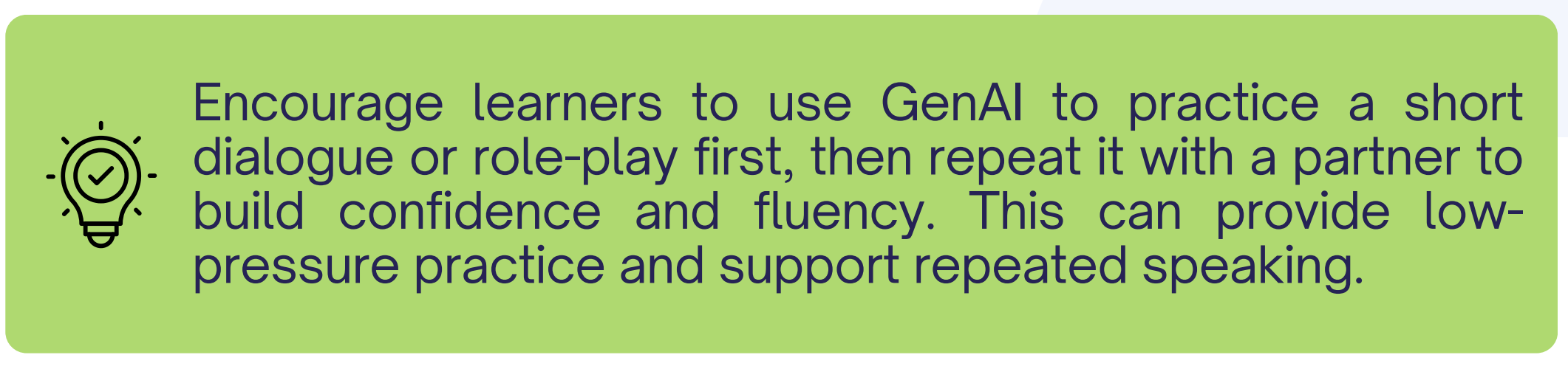
Learners noted that GenAI supported speaking primarily through conversation practice, role-plays and presentation preparation. For example, learners described using it more independently outside the class for “daily conversation practice,” asking it to “have a simple conversation about my day” and correct errors, while another learner, who finds “dialogue speaking” to be “very difficult” explained that GenAI helps with “dialogue and roleplay presentation[s].” One teacher observation highlighted how learners “spoke continuously, made eye contact, and interacted naturally,” after first practicing with GenAI. Another teacher's reflection described how students spoke to their phones or computers with noticeable engagement.
Thus, GenAI can offer extended speaking practice opportunities for learners who need additional support and repetitive practice before speaking publicly, acting as a highly supportive, low pressure speaking partner.
Image spot: SpeakingAdd speaking-tip.png to the images folder.
-replace me with an image caption-
Vocabulary
GenAI assistance in vocabulary development was one of the prominent themes in the learner data. Learners used GenAI to better understand meanings, find synonyms, and broaden their vocabulary knowledge outside the classroom during independent study. One learner described entering about “70 new words” into GenAI and prompting it to create exercises and sentences to help them remember. Another explained how they took pictures of a five-page story and used GenAI to adapt the text to a lower level such as “B1 [or] B2” to help them read the book “effectively”. These are clear examples of how learners were not only looking up isolated meanings but also using GenAI to grade existing materials more appropriately and enhance vocabulary learning through repetition, sample sentences, and contextualized practice.
Image spot: VocabularyAdd vocabulary-tip.png to the images folder.
-replace me with an image caption-
Grammar
-replace me-
Image spot: GrammarAdd grammar-tip.png to the images folder.
-replace me with an image caption-
Writing
Learners reported using GenAI to support their writing, and in particular, prepare for writing assessments, practice writing emails, improve spelling and revise their work. One learner stated, “I use ChatGPT a lot… for prepare for my test, like for writing” and described receiving help with email writing and then revising work after its feedback. Another learner mentioned that writing with ChatGPT was “good for me,” while another described that they learned spelling through writing with it. Recent research on AI-assisted writing concluded that ChatGPT had a significant positive impact on academic writing of ESL learners, specifically as a feedback tool (Mahapatra, 2024). This support in writing was identified as one of the most common and promising areas of ChatGPT use in ESL education (Lo et al., 2024).
It is evident that the learners in this study were using GenAI to draft, review and improve their own writing rather than simply generating text through it.
Image spot: WritingAdd writing-tip.png to the images folder.
-replace me with an image caption-
Pronunciation
Even though pronunciation appeared less frequently in the data than other skills, it was noted as an area in which learners sought support from GenAI. According to the learner feedback, pronunciation often appeared in relation to speaking practice, which was done outside the classroom. For example, one learner explained that in daily conversations with GenAI, they were able to identify errors related to pronunciation. According to recent research, GenAI can support second language pronunciation through production practice and listening practice (Mompean, 2024). Thus, pronunciation support may have been embedded in conversation practice, where learners used GenAI output to notice pronunciation errors while speaking.
Image spot: PronunciationAdd pronunciation-tip.png to the images folder.
-replace me with an image caption-
Other Uses of GenAI in Daily Life
The objectives of this study were to facilitate learner autonomy and language skill development through a scaffolded introduction of GenAI in the classroom. However, additional uses of the tool were discovered by learners, some of which were unexpected but incredibly beneficial.
According to data, learners’ use of GenAI in daily life became more frequent, practical, personal and meaningful over time. Prior to the course, GenAI use appeared to be limited and was primarily used as a search tool for general information. Some learners stated using it only “a little,” only for “specific question about information,” or occasionally for practical purposes such as browsing cars, price matching, finding new recipes or studying for exams. This suggests that in some cases, GenAI was present in learners’ lives mainly as an occasional information tool before being formally introduced in the classroom via this study.
Indeed, survey and interview data indicate that after classroom introduction, learners’ use of GenAI broadened considerably and became more integrated into their daily life. One learner explained that they used GenAI to help find their lost backpack; she followed the instructions, used the provided email template, and recovered the item in less than 24 hours. It is evident that GenAI became invaluable for newcomers who did not always have friends or relatives to offer guidance. The teachers’ reflections and classroom observations support this shift where classroom activities appear to have helped learners see GenAI as a more useful and flexible tool that could be applied beyond language learning in the classroom. By the end of the study, GenAI moved from being perceived as a limited source of general information to a more practical tool for daily problemsolving, settlement and family support.
When presented with a new concept, technique, or tool, teachers must consider how best to implement this in their specific teaching context. The following is a summary of pedagogical best practices, which can support teachers introducing GenAI to their English language classroom. These best practices can be applied to any activity a teacher wishes to do with their learners and are based on the descriptions, observations, and reflections of the research team during this study.
Pedagogy
-replace me-
Explicit Instruction
The merits of deductive versus inductive instruction in English language teaching methodology have long been contested, especially for novice learners. However, taking into consideration more recent research and theories regarding information processing, working memory capacity, and cognitive load theory, perhaps it is advisable to err on the side of caution. Operating in another language, such as English, already puts pressure on learners’ cognitive capacity, so limiting the amount of new information or decision-making they encounter is crucial. Thus, when first introducing GenAI to learners, providing explicit instruction, and the exact prompt, help them to manage the number of cognitive demands. As in language teaching, once learners demonstrate basic understanding and possess shared assumed knowledge, the teacher can then engage in more discovery learning with the tool.
The need for explicit instruction applies to learning how to use the tool itself, but it also applies to how learners use it to practice the language. In the English language classroom, ideally learners would be engaging with GenAI to either learn about the language, or to practice the language. However, learners may not possess the pedagogic understanding of how languages are learned or practiced. Explicit instruction can be used to direct learners in carrying out the task appropriately, so that the task or practice is effective.
For example, learners may be asked to use GenAI to research a certain topic and then engage in a jigsaw speaking activity (see below for further explanation). The aims of this activity might be to activate schemata before a reading text, and practice spoken fluency. However, if learners write down full sentences produced by GenAI and then proceed to read those sentences aloud, they are not actually practicing spoken fluency. Thus, learners need to be instructed to a) take notes, focusing on key words, when researching from GenAI and, b) turn over their phone when they are ready to begin the speaking task. Explicit instructions are helpful in ensuring teachers achieve their aims in the classroom and increase the likelihood that learners can replicate similar practice activities independently and effectively at home.
Explicit instruction can help minimize the cognitive load learners are faced with when acquiring a new (digital) skill in a new language. It can also help to reinforce teachers’ aims, ensuring their activities achieve what they intend to. Lastly, explicit instruction can help to remove the ‘mystery’ from language learning, increasing the likelihood that learners are able to replicate the activities at home.
Scaffolding
Originally borrowed from sociocultural theory, the concept of scaffolding has made its way into mainstream language teaching pedagogy. When new knowledge is scaffolded, it is broken down by an expert, or teacher, into manageable chunks for their learners. Once learners have mastered the new knowledge or skill, it can become assumed knowledge, and the challenge level can be increased again. Indeed, this practice can also be adopted when introducing GenAI to English language learners.
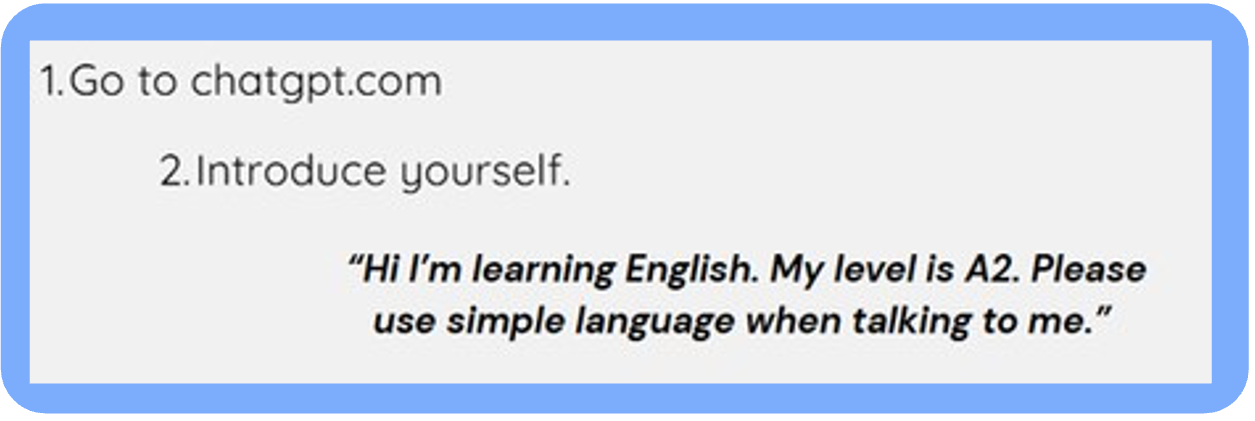
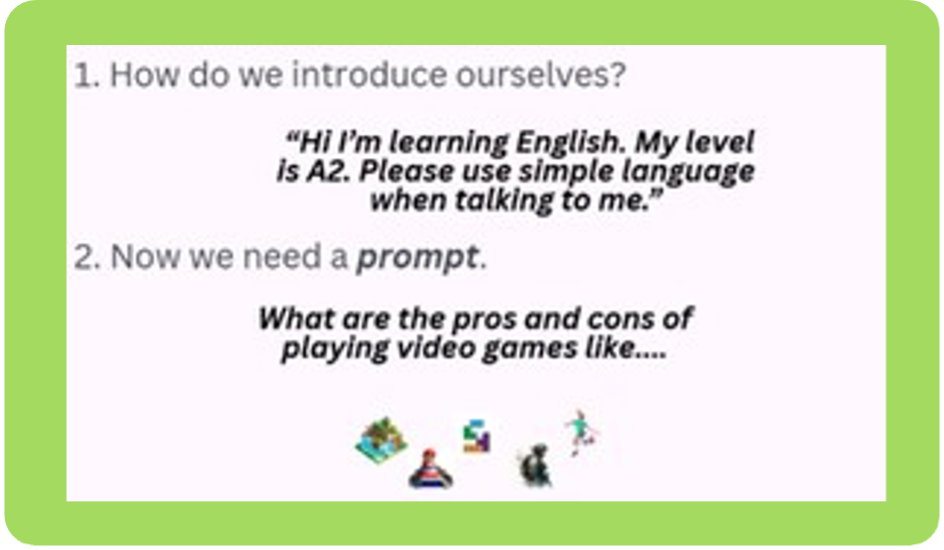
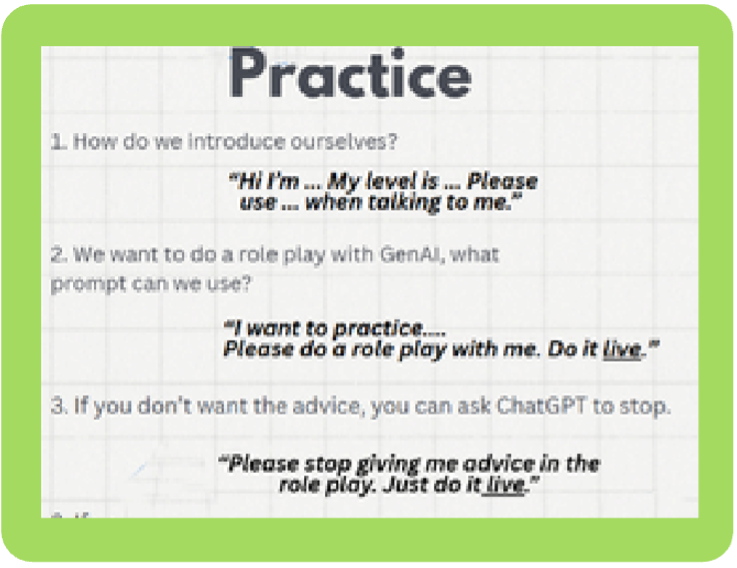
When engaging with GenAI, the user is required to first input information. This comes in the form of a prompt. Prompt-writing is a skill unto itself. For this reason, providing learners with the exact prompt is the best starting point. Before inputting the prompt, it is helpful to unpack it with them. This can be done through open class elicitation: Why do we need to introduce ourselves to the digital tool? Why do we need to include our level?
This discussion will begin to shape the learners’ understanding of GenAI; they can influence its output through their input.
Once learners have introduced themselves to the tool, an additional prompt can be provided. The prompt can be complete or partial, allowing the learners to tailor it to meet their needs.
As the learners’ comfort level with GenAI increases, knowledge can begin to become assumed. For example, instead of providing learners with the introductory prompt, it can be elicited from the class. Additionally, subsequent prompts can be elicited from learners through probing questions like: What prompt can we write to find out about X? Do we need to give the tool any additional information?
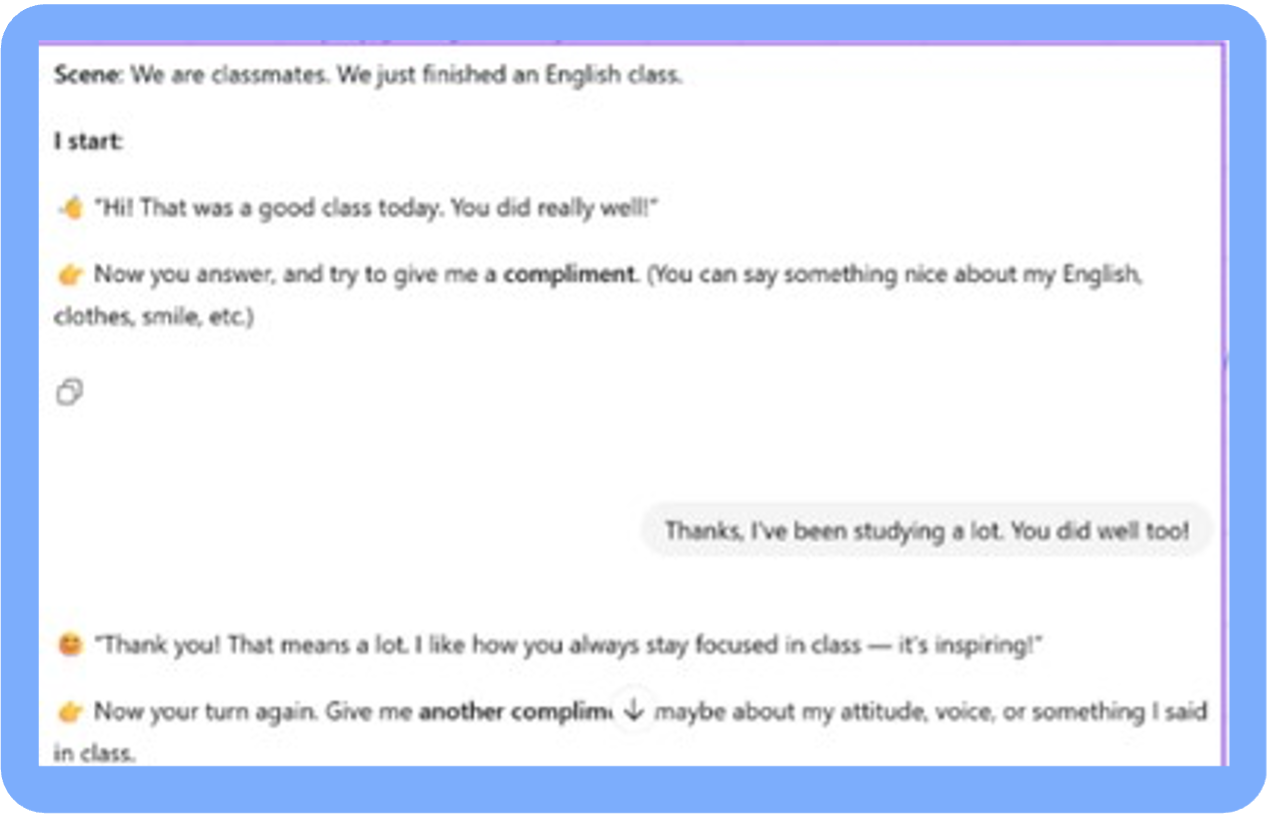
When introducing different task types to learners, such as role plays, it’s helpful to provide them with a visual representation of what they can expect; this can take the form of either a screen grab or conducting a live demonstration with the tool. This, too, helps shape their
understanding of the tool; the learners can see that the tool is adaptive, responding to their output in real time, and not predetermined.
Once learners are comfortable with writing the initial prompts, they can then focus on refining the tool’s output. For example, when engaging in a
live written role play, GenAI often tries to guide user output in the form of suggestions or corrections. While this is certainly appreciated by some, keeping this feature on can also interrupt the flow of conversation and even detract from the fluency aim. Learners require explicit instruction in this regard, as they need to be reminded that the tool is responsive, and attends to context, allowing them to influence its output to fit their needs or preferences.
Whenever learners are engaging with GenAI, it is crucial that teachers monitor actively. Through monitoring, they can gather important information regarding learners’ comfort level and proficiency with the tool. In the faceto-face classroom, this takes the form of moving around the class and peering over learners’ shoulders, while in an online class, learners need to be in break-out rooms and sharing their screens. Teachers can monitor unobtrusively to help build their confidence with the tool. Conversely, teachers can intervene if the learners are having difficulty, or if there is an opportunity to guide them in understanding the tool’s more advanced capabilities.
Scaffolding is necessary to account for the range of GenAI proficiency that could exist within one class. Scaffolding minimizes the number of new digital skills students are encountering at one time, increasing the likelihood that these skills will be learned and replicated in the future.
Scaffolding: Introductory PromptAdd scaffolding-intro-prompt.png to the images folder.
-replace me with an image caption-
Scaffolding: Follow-Up PromptAdd scaffolding-follow-up-prompt.png to the images folder.
-replace me with an image caption-
Scaffolding: Role-Play ExampleAdd scaffolding-role-play.png to the images folder.
-replace me with an image caption-
Scaffolding: Practice PromptAdd scaffolding-practice-prompt.png to the images folder.
-replace me with an image caption-
Interaction
In communicative language teaching, teachers are encouraged to use a variety of interaction patterns: whole class, groupwork, pair work and even students working on their own. Indeed, each interaction pattern has its own merits and potential drawbacks.
When learners work alone, they can feel less pressure than in a larger group setting, the energy in class shifts from boisterous to tranquil, and learners have an opportunity to contemplate and practice new concepts, on their way to becoming autonomous learners. These benefits also exist in activities incorporating GenAI, in which learners are working alone on their devices. However, there are some additional benefits. Through interacting with the tool, learners are afforded more opportunities for spoken or written fluency practice. In addition, the tool is a ‘knowledgeable partner,’ supporting the learner linguistically or affectively when the teacher may be assisting another learner elsewhere. By encouraging this interaction (i.e. student-device) in the classroom, the teacher is signaling that it is both valid and valuable, increasing the likelihood that learners will engage with the tool at home. The student-device interaction pattern affords the benefits of both individual and pair work, and should be recognized as such when teachers are lesson planning.
Reflection
Planning, monitoring and evaluation are regarded as the three key categories of metacognitive strategies for English language learners. These strategies are practiced through different types of activities. An example of a planning strategy is predicting content from the text title. Gauging their progress midway through an activity and reacting accordingly is an example of a monitoring strategy. Evaluation strategies include those in which learners reflect on their performance and suppose what could be done differently to improve their performance moving forward. In this study, the teachers utilized evaluation strategies to reinforce learning, or to further learning beyond the activity at-hand.
Following any activity using GenAI, teachers can engage in a reflective discussion with their learners. These discussions can centre around different aspects of the tool, such as prompt-writing, or shaping GenAI output. Reflective questions could include: What happened if you didn’t state your language level in the initial prompt? What happened when you included your reason for asking? What prompt did you give it to change its output? Did you find the exact same information as your partner? Why not? Active monitoring during the GenAI-integrated activities can inform the teacher as to what topics or skills could be broached in the post-activity discussions. These discussions are instrumental in shaping learners’ understanding of GenAI, and reinforcing strategies and skills needed to work with the tool effectively and can be carried out in pairs, groups or as a whole class.
The ethical use of GenAI is one topic that greatly concerns teachers as it has the potential to significantly undermine their assessments. Its ethical use is a topic that can be easily broached during a reflective discussion following an activity. For example, after an activity in which learners used GenAI to help prepare to give a mini presentation in class, the teacher could solicit prompts that were used to ensure the digital tool didn’t complete the presentation for the learners. The teacher could also ask what would happen if a learner used GenAI to complete an assessment for them. The teacher can use these discussions to reinforce the idea that GenAI tools should be used to support, not replace, learners’ thinking.
Teachers can also use these discussions to help illustrate how the activity benefited their language learning. Following an in-class GenAI activity, the teacher can ask learners very explicitly: What were we practicing in this activity? Why is it helpful to practice accuracy before fluency? This can give learners insight how languages are learned. Teachers can also ask learners to reflect on the difference between two activities, such as a role play that was completed with GenAI versus with a real partner. While the real partner role play was certainly more authentic and engaging, it doesn’t necessarily mean that the GenAI role play was ineffective; a discussion on its merits could be had here. Through these reflective discussions, the methodology becomes explicit; adult learners can then use this understanding to inform their own study habits, promoting learner autonomy at home and in the future.
Reflection can be used to reinforce digital skills practiced during the activity such as prompt-writing, and can also be used to broach essential topics, such as the ethical use of GenAI. At the same time, teachers can use these reflective discussions to make their methodology more explicit, helping their adult learners to better understand how languages are learned. These types of reflective discussions are helpful in clarifying how to use this digital tool effectively, and how it is helping them to learn the language.
Over the course of the semester, learners took part in more than 10 activities using GenAI. The activities had various pedagogic aims, such as activating schemata, practicing the written accuracy of certain grammatical forms, practicing spoken fluency within a specific context, etc. Below you will find the most cited activities by the teachers and learners based on student engagement, and pedagogic value. These activities can be adapted to fit most teaching contexts; the only prerequisite is that learners have access to a digital device, such as a phone, tablet or computer.
Jigsaws
Jigsaws are a familiar activity type in English language education. In a jigsaw, learners are divided into groups and these groups each receive different information via a written text, audio, etc. The teacher then regroups the class so that the new groups are comprised of one member from each of the former groups. The aim of the activity is that learners share their information with their new group in order to complete a task. Completing the task is what necessitates learners to convey their information accurately and efficiently to their group. Pedagogically, jigsaws can be used to practice reading, listening, or speaking, but they can also be used at various points in the lesson, such as early on to activate schemata, or midway through a lesson to present a language point via a text.
Below are two examples of jigsaws in which the learners used GenAI to learn about a topic. This information was then shared with the class to different ends.
Inventions from your Country
The most cited activity by learners was one in which they were tasked with researching inventions from their countries. This activity was used to introduce the coursebook unit topic of technology. Learners were instructed to use GenAI to find out the following information: three inventions from their country, when they were invented, and their uses. While ‘Googling’ this information would also be possible, GenAI is superior because its output can be graded for different language levels. GenAI is also able to synthesize large amounts of information for its users, who can then also ask follow-up questions. Learners needed to take notes on their findings, as they would be asked to put their devices away when they were grouped. After completing their research individually, they were regrouped and told to share the inventions they learned about. The goal of the activity was to decide which invention was the most impressive in each group. The most impressive inventions were then shared with the rest of the class during whole class feedback.
High student engagement was observed, likely due to the fact that it was personalized; they were learning something new about their own countries, such as the incredible accomplishments of their people. Learners then felt a sense of pride when sharing this information with their classmates. As a result, they were motivated to share their information and listen to their classmates to compare the many achievements.
This activity could be adapted to focus on any topic from the learners’ countries, such as the meaning of their flag, or the most popular tourist sites. Whichever topic is chosen, it should be approachable and interesting for both the researcher and the listener, which will ensure that everyone is motivated to participate.
Preparing for a Field Trip
A jigsaw can also be used to prepare learners for a field trip. In the case of this class, they were preparing to visit a conservation area which included a rare meromictic lake and a recreation of an Iroquois longhouse village from the 15th century. The teacher hypothesized that during the tour, the guide would be using some technical geological or anthropological vocabulary, which would otherwise be a barrier for the A2 learners in her class.
In the class prior to the field trip, the teacher identified some key geological, environmental, Indigenous, and archeological themes that the learners might encounter on the field trip. She then assigned each group one area of expertise, and some guiding questions to help them research, such as: How was the Iroquois village discovered? What is a longhouse? Why is Crawford Lake so special? The groups used GenAI to help them to understand and explain these key ideas and terminology. They were then regrouped and shared their findings. Learners were motivated to complete this activity, knowing it would enhance their field trip experience.
Following the field trip, the teacher asked the class to reflect on how the activity had helped them prepare for the excursion, and whether they felt it was useful. The answers were resoundingly positive. The teacher also inquired as to whether learners could do this on their own, before visiting somewhere new, like a tourist attraction, or a different city. By posing this question, the teacher is increasing the likelihood that learners will replicate this activity at home, becoming more autonomous, and taking responsibility for their own learning.
Role Plays
Role plays are another familiar activity to English language teachers. They are often used to practice a specific language point, such as a language function or verb tense, and overall fluency. A good role play includes tension; a point of disagreement which the learners must overcome, or a task they must complete. Role plays can even the playing field in class, as they allow for more reticent learners to adopt a different persona or responsibility, thereby increasing the likelihood that they will engage more.
Below are two examples of role plays learners conducted with GenAI, one written and one spoken. Coincidentally, both teachers were using them to practice the same language point, but for different pedagogical purposes. Unlike traditional role plays, the learners aren’t adopting different personas, but in some cases, GenAI is.
Interviewing a Famous Character
In this written role play, learners interviewed a famous person about a ‘secret topic.’ This role play took place after the presentation of the present perfect. Learners were provided with a prompt: “I am a historian from 3050 and interested in learning about the past. Pretend you are….” They could then choose who they wanted to interview (e.g. Cleopatra, William Shakespeare, a medieval knight). Each famous person was also paired with a ‘secret mission’ (e.g. ‘ask about food, ‘ask about discoveries’). Learners then individually began interviewing their famous person, simulated by the GenAI tool, via text. They were expected to note down the famous person’s answers, which would then be shared with their classmates during whole class feedback.
Learners were very engaged in this role play, likely because they had a choice over who they interviewed. Giving them choice allowed them to explore their own interests and take ownership of the task. It also allowed them to successfully practice the present perfect question form, ‘Have you ever…?’ During feedback, learners were also employing the present perfect to explain their interviewee’s experiences.
Written role plays with GenAI are an excellent way to provide semirestricted or freer written practice of a specific language point. Through writing, learners are afforded more time to compose their responses. They can also benefit from the ‘language tips’ GenAI provides throughout the interaction.
Interviewing GenAI
In this spoken role play, learners were interviewing GenAI in order to prepare for a real interview with a classmate. In this way, GenAI was being used to scaffold the subsequent speaking practice. The teacher was also using this activity to demonstrate another GenAI capability that could be used at home to practice speaking.
This group of learners had already been introduced to the present perfect and was now exploring how the present perfect and past simple are used in tandem when discussing life experiences. Following the presentation of the language, learners were instructed to write down a few questions they wanted to ask their classmates regarding their experiences (e.g. scuba diving, rock climbing, travelling), as well as some follow-up questions using ‘when,’ ‘why’ or ‘where.’ They had been asked to bring earphones to class, so as to not disturb one another when carrying out the role play.
Before starting the role play, the teacher did a live demonstration, showing the learners how in speaking they can still instruct the tool to ‘use simple language’ or ‘slow down when you’re talking.’ Learners then began the role play, asking GenAI their questions, and tailoring their follow-up questions based on the tool’s responses. Following the role play with GenAI, the teacher paired up the learners to interview one another with the goal of finding similarities. During whole class feedback, the teacher then elicited whether the learners felt the GenAI interview had helped to prepare them and which interview they preferred. While they all preferred the real interview with their classmate, they recognized the benefit of having practiced with GenAI beforehand.
Learners were incredibly engaged in this activity and could be seen smiling throughout. The teacher noted that the first time the spoken role play activity is introduced, it shouldn’t be tied to a specific language aim, as learners are quite surprised by this GenAI capability. In addition, once learners become proficient in setting up and carrying out a spoken conversation with GenAI, this type of role play needn’t be repeated often in class, as it is more appropriate for practice at home.
Inquiry-based
Inquiry-guided learning (IGL) is a framework for learning that “… promotes the acquisition of new knowledge, abilities, and attitudes through students’ increasingly independent investigation of questions, problems, and issues” (Lee, p. 6, 2012). Being a framework, IGL encompasses the pedagogy, curriculum, and assessment practices of a course, and possibly even the institution. The premise of IGL is appealing to the post-secondary English language classroom. As adult learners, these individuals enter the classroom with diverse life experiences, expertise and knowledge. Through incorporating activities involving IGL, the teacher is acknowledging the unique positionality of all her learners. Allowing space for personal inquiry increases learner engagement. One way to facilitate IGL is through integrating GenAI into classroom activities.
Who are the Darhads?
This inquiry-based activity involved learners using GenAI in order to learn more about a nomadic tribe living in remote Mongolia: the subject matter of an audio they eventually listened to. The aims of this activity were to activate schemata and pique learner interest in an otherwise unfamiliar topic, both of which would prepare learners for the subsequent listening.
The learners began by looking at images and reading a short paragraph about the Darhad tribe. They were then instructed to write down three questions they had about the tribe; questions could be about their way of life, customs, survival, Mongolia, etc. They then posed the questions to GenAI, noting down the tool’s responses. The learners inquired about schooling, currency, laundry, Mongolian industry; indeed, every learner’s interests and perspective were apparent in their individual inquiry. Upon completion, the learners mingled around sharing what they had learned about the tribe and Mongolia. They were tasked with trying to find the most interesting fact.
Whole class feedback involved eliciting what interesting facts they learned about the Darhads, which then segued into the listening activity. Based on learner proficiency with the GenAI tool, a discussion related to the accuracy of the information could follow. The teacher could ask: How do we know if this information is true? Where can we check if this is correct? In a subsequent class, the GenAI-integrated activity could be focused on sources, and their reliability. For example, learners could ask GenAI for its sources, and compare the information with legitimate sources, such as learner encyclopaedias.
The learners enjoyed this activity because they loved learning about an entirely new culture. It honoured the innate curiosity that adult learners have and allowed them to satisfy it. This activity could be used to precede any text or audio topic learners are unfamiliar with. The requisites are that learners be introduced briefly to the topic to provide context and then given the freedom to explore it independently and share their findings.
Canadian Customs
This inquiry-based activity involved learners using GenAI to learn more about Canadian culture, in particular customs related to entertaining. This activity took place early in the semester and was the first GenAI-integrated activity done with the class. The aim of this activity was threefold; learners would be learning about one another’s culture, as a means of establishing rapport. They would also be learning more about Canadian culture, a place they currently all call home. Finally, it would provide common ground for a role play that would take place later in the lesson, involving functional language for inviting, and accepting/ declining invitations.
First, learners were grouped with other nationalities and discussed party customs in their country. They were provided with the subtopics: invitations, gifts, and arriving/ leaving. In groups, they shared their customs. In whole class feedback, the teacher elicited any similarities, highlighting any stark differences, and then asked: Do you think it’s the same in Canada? This moment of reflection created an opportunity to present the GenAI tool as a means of finding out. The teacher did a live demonstration with the class, eliciting a specific social custom they were curious about. The learners then independently asked the GenAI tool their questions about Canadian social customs, and noted down their answers. In feedback, they shared their discoveries with their classmates.
The learners enjoyed this activity because it was directly related to their life in Canada; they recognized the importance of understanding the social customs when adjusting to life in a new culture. Learners were given the freedom to ask the GenAI tool about whichever social customs applied to them, or they were concerned about. This activity could be adapted to different cultural customs, such as dining, business, or transportation etiquette or even certain laws. To be successful, learners need to recognize the importance of these customs, and they need to be relevant to their lives.
This study sought to explore how GenAI could support the development of learners’ digital literacy, including critical awareness, as well as learner autonomy. Yet through conducting the research, additional learner benefits emerged, such as newcomer settlement support and daily problem-solving. This toolkit is the product of classroom experimentation and observation, teacher reflection, and learner feedback. Included in this toolkit is a summary of best practices, which provide teachers with clear rationales and detailed steps for introducing GenAI into the classroom and conducting GenAI-integrated activities. Also included are ‘teacher tips’ and sample classroom activities, which can be immediately adapted and implemented into the classroom. While this toolkit provides the reader with a good pedagogic foundation for introducing GenAI into the English language classroom, we recognize that there is further research to be done, including if and how experienced users of GenAI utilize the tools to support their language learning. We hope this reading has proven to be worthwhile and provided an opportunity to reflect on the needs of your learners. In such a fast-paced and technologically advanced world, it is imperative that our learners’ digital literacy and language skills are supporting and not hindering their success.
A Final Note from the Authors
HAYLEY GOODWIN
Participating in this research project has been incredibly worthwhile on a professional and personal level. I’m a firm believer in strong pedagogy and keeping it simple in the classroom, and this project initially challenged those beliefs. However, in planning and carrying out the classroom activities, I recognized that strong pedagogy is still a requirement, and that GenAI is not just a passing trend. Indeed, it’s a knowledgeable assistant that can support its user in myriad ways to further their language learning both in class and at home. Conducting the interviews at the end of the project was highly rewarding as I heard first-hand about the additional digital skills learners acquired and how much they appreciated our efforts to support them. Personally, I appreciated working with such a diverse and talented group of women and valued the perspective and experience that each of them brought. Above all, this toolkit is a demonstration of the power of collaboration in practice.
SARA MACHAN
This project has been an invaluable learning opportunity in the field of emerging technology and its impact on the modern ELT student. AI, being a hot topic at the moment, has many pitfalls and negative critiques, especially in terms of academic integrity in the classroom. With many educators uncertain or unwilling when it comes to including GenAI in the classroom, it was enlightening to explore its positive uses for student growth and learning. I enjoyed exploring in the classroom and using AI in creative and useful ways to enhance my teaching and lessons. This has been an experience that has allowed me to challenge my current practices and expand my teacher tools to benefit my students’ experiences in the classroom. I believe this action research has deepened my understanding of ELT students and their language learning journeys.
MADHUMINI RAJAPAKSE
As an individual who has always believed that GenAI is a resourceful tool, I often used it in lesson planning and in adapting lessons for my learners. Even though it had already become quite popular among ESL teachers as a teaching resource, it was rarely introduced in the classroom to support learners directly. Eventually, I decided to introduce it in the classroom, only to realize the importance of using this tool in a more guided and meaningful way, because it is often associated with plagiarism in educational contexts. This study became a valuable opportunity to further explore that possibility. It provided greater insights into how GenAI can be used in the classroom as an assistant. This study shows that adult ESL learners can benefit from GenAI when it is used in a more systematic and reflective manner. It not only supports skill development but also promotes digital literacy and learner autonomy. For me, it is rewarding to witness how learners have gradually become more independent and more responsible when using this tool. They have begun to use it in more creative ways outside the classroom to address their own needs and take more control over their learning.
DANA VICTOR HAZIN
As the Student Researcher for this project, I had the privilege to observe Hayley and Sara experiment with GenAI in their classrooms. This opportunity gave me a strong outside look, as I witnessed firsthand the tool's transformative effects on both students and educators. It was very interesting to see how learners moved from a sense of surprise that a teacher would ever encourage the use of AI to an understanding of how it can be effective for their language learning. For teachers, I have seen how GenAI acted as a catalyst for pedagogical inspiration and creativity. There were times when I would tell myself that there wasn't much more to be tried or discovered. In many accounts, however, I was proven wrong, as many AI integrated activities involved innovative ways to practice language skills. Before this project, I was hesitant to use GenAI as part of my pedagogy but with more exposure, I got the courage to try it. Gradually I gained the confidence and comfort to integrate it in my teaching practice.
Guan, W., & Bahari, A. (2026). Evaluating AI-enhanced collaboration in EFL academic writing: A longitudinal mixed-methods study. Journal of Educational Computing Research, 64(4), 951–988. https://doi.org/10.1177/07356331251404736
Harmer, J. (2015). The practice of English language teaching (5th ed.). Pearson Longman.
Izumi, S., Bigelow, M., Fujiwara, M., & Fearnow, S. (1999). Testing the output hypothesis: Effects of output on noticing and second language acquisition. Studies in Second Language Acquisition, 21(3), 421–452.
Karataş, F., Abedi, F. Y., Ozek Gunyel, F., Karadeniz, D., & Kuzgun, Y. (2024).
Incorporating AI in foreign language education: An investigation into
ChatGPT’s effect on foreign language learners. Education and Information
Technologies, 29, 19343–19366. https://doi.org/10.1007/s10639-02412574-6
Lee, V. S. (2012). What is inquiry-guided learning? New Directions for Teaching & Learning, 2012(129), 5–14. https://doi.org.library.sheridanc.on.ca/10.1002/tl.20002
Lethaby, C., Mayne, R., & Harries, P. (2021). An introduction to evidencebased teaching in the English language classroom: Theory and practice. Pavilion Publishing & Media Ltd.
Lo, C. K., Yu, P. L. H., Xu, S., Ng, D. T. K., & Jong, M. S.-Y. (2024). Exploring the application of ChatGPT in ESL/EFL education and related research issues: A systematic review of empirical studies. Smart Learning
Environments, 11(1), Article 50. https://doi.org/10.1186/s40561-024-00342-5
Mahapatra, S. (2024). Impact of ChatGPT on ESL students’ academic writing skills: A mixed methods intervention study. Smart Learning Environments, 11(1), Article 9. https://doi.org/10.1186/s40561-024-00295-9
Mompean, J. A. (2024). ChatGPT for L2 pronunciation teaching and learning.
ELT Journal, 78(4), 423–434. https://doi.org/10.1093/elt/ccae050
Schmidt, R. (1990). The role of consciousness in second language learning. Applied Linguistics, 11(2), 129–158.
Scrivener, J. (2011). Learning teaching: The essential guide to English language teaching (3rd ed.). Macmillan Education.
Szabó, F., & Szoke, J. (2024). How does generative AI promote autonomy and inclusivity in language teaching? ELT Journal. Advance online publication. https://doi.org/10.1093/elt/ccae052
UNESCO. (2024, September 3). What you need to know about UNESCO’s new AI competency frameworks for students and teachers. https://www.unesco.org/en/articles/what-you-need-know-about-unescosnew-ai-competency-frameworks-students-and-teachers
World Economic Forum. (2025). The future of jobs report 2025. https://reports.weforum.org/docs/WEF_Future_of_Jobs_Report_2025.pdf
Yu, R. (2020). On fostering learner autonomy in learning English. Theory and Practice in Language Studies, 10(11), 1414–1419.
https://doi.org/10.17507/tpls.1011.09